

It seems that everyone’s doing it these day – redrawing Congressional districts to benefit one party over another. Republicans redrew the map of Texas, and California Democrats responded with a gerrymander of their own – or is it the other way around? It’s one of those messes where we don’t know who to blame.
Just like the Russiagate scandal surrounding the 2016 Presidential election: Was there Russian interference in the election, or was it manufactured by Democrats to make Trump look bad? Or, as the Dems assert, was foreign interference encouraged, even manufactured, by Trump himself, to ensure his win?
Going down the rabbit hole: Blends and portmanteau words
No matter which side of the aisle you’re on, the fact is that there’s an indelible connection between today’s gerrymanders and the last decade’s Russiagate. No, it’s not a nefarious partisan conspiracy, or a loony conspiracy theory held by the other side. It’s a linguistic connection: Both ‘gerrymander’ and ‘Russiagate’ are words coined to meet the moment, made out of material from existing words, what linguists call ‘blends’.
Alice in Wonderland author Lewis Carroll also termed such words ‘portmanteau words’’, since they involve, as Humpty Dumpty explained to Alice, “two meanings packed up into one word.”
Blended brand names
Words that originated as blends can be found in everyday words like ‘smog’ (‘smoke’ + ‘fog’), ‘motel’ (‘motor’ + ‘hotel’), ‘brunch’ (‘breakfast’ + ‘lunch’), and ‘podcast’ (‘pod’ + ‘broadcast’). They also feature in brand names, for example ‘Microsoft’ (‘microcomputer’ + ‘software’), ‘Verizon’ (‘veritas’ + ‘horizon’), and ‘Tofurky’ (‘tofu’ + ‘turkey’).
Linguists who apply their knowledge of language structure and meaning to legal questions, forensic linguistic experts, may be called upon in trademark disputes involving blended brand names and their meaning connotation.
Does ‘Verizon’ invoke ‘truthful horizons’, or is it primarily the name of a large telecommunications provider? And does anyone associate ‘Microsoft’ with ‘microcomputers’? Nowadays we just call them ‘computers’ – or smart watches.
And then there are political blends.
Gerrymanders and ‘gate’-scandals
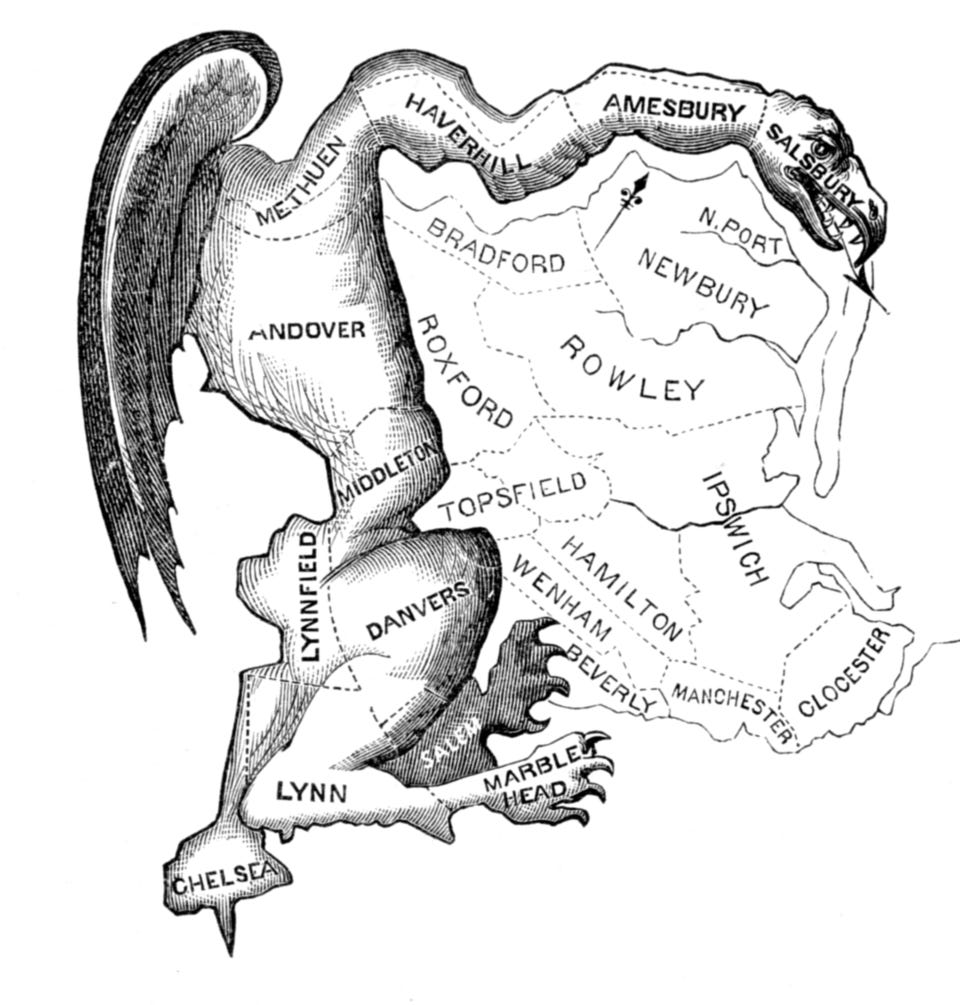
The word ‘gerrymander’ is a blend of ‘Elbridge Gerry’, the name of an early 19th century Massachusetts politician, and ‘salamander’, a creature known for its winding shape. Gerry, a Democratic-Republican (can you imagine such a party today?!) was called out by his Federalist rivals for his support of one particularly slithery district, and his name was cemented into history when a political cartoon appeared in the Boston Gazette depicting the mythological monster, ‘The Gerry-Mander’.
‘Russiagate’ is one of many blends ending in ‘gate’ – from the notorious Watergate scandal that ended Nixon’s presidency. ‘Watergate’ started as a perfectly innocent name for an office complex on the shores of the Potomac in Washington, DC. Until the infamous break-in on June 17, 1972 – 54 years ago to the day. Now the name is so indelibly associated with corruption and dishonesty that even its last syllable, ‘gate’ is enough to convey that something’s not right. Its use is particularly rampant in the political sphere, where it originated.
For example, if you’re of a certain age, you may remember ‘Billygate’, ‘Contragate’, ‘Monicagate’, and ‘Pizzagate’. ‘Gate’ words also extend beyond politics, to sports (‘Deflategate’), sports half-time shows (‘nipplegate’), and concerts without the sports (‘Coldplaygate’).
And there’s even a ‘gategate’, a British scandal involving Member of Parliament Andrew Mitchell, who in 2012 allegedly called a police officer a ‘pleb’ after being asked to leave Downing Street through a different gate.
Re-cutting and word-building
Blends like ‘gerrymander’ are particularly fun for linguists because they involve a process called ‘re-cutting’ or ‘re-bracketing’, where the original parts of a word are cut up differently and then used as novel prefixes and suffixes, or words in their own right. The word ‘suburb’ is a recut form of ‘suburban’ involving not the original meaning parts, ‘sub + urban’ but instead ‘suburb + an’; ‘the word ‘condo’ is similar, a recutting of ‘con + dominium’ (‘joint’ + ‘property’).
Farther back in linguistic history, re-cutting between articles and nouns also gave us new words: ‘an apron’ used to be ‘a napron’, ‘a nadder’ became ‘an adder’, and the word ‘nickname’ comes from the Middle English ‘an ekename’ – an ‘also-name’. And we’re still doing this today, but that’s ‘a whole nother’ story (re-cut from ‘an + other’).
‘aholics’, ‘cations’, ‘verses’, and other creative suffixes
Some re-cuttings are one-offs; there don’t seem to be too many new words ending in ‘mander’ that carry associations of unfair partisan advantage. But others are highly productive, used to make all sorts of new words.
For example, there’s ‘aholic’, a re-cutting from ‘alcohol+ ic’ now applied liberally to create words for people addicted to everything from chocolate to pizza to shopping to work. There’s also ‘cation’ (from vacate+ion), which gives us ‘staycation’, ‘playcation’, and even ‘workcation’; ‘iterati’ (from ‘literate + i’), featured in ‘glitterati’ and ‘digerati’; and, recently, ‘verse’ (from ‘universe’), now also found in the ‘multiverse’, ‘Twitterverse’ (now ‘X-verse’), and ‘metaverse’.
Technology, economics, and re-cutting
Productive prefixes include other tech-related terms like ‘cyber’ (from ‘cybernetic’), as in ‘cyberspace’ and ‘cyborg’, and ‘web’ (from ‘World Wide Web’), as in ‘webinar’ (‘web + seminar’) and ‘weblog’ (‘web + log’), now shortened to ‘blog’. And now ‘blog’ is used to make new words of its own, for example ‘blogosphere’, bloggerati’, and ‘blogoverse’ – all three of which feature not just one but two re-cuttings.
Back in the political realm, when we’re criticizing politicians’ handing of the economy, we love to throw around terms like ‘stagflation’ (‘stagnant + inflation’), ‘shrinkflation’, and ‘tipflation’, all featuring the productive suffix ‘flation’.
And while ‘gate’ isn’t technically a re-cutting, it’s clearly a highly productive suffix, cut from an existing word where it has a different meaning, as it seems like there’s a new ‘gate’ scandal just about every day.
Libfixes aren’t just for liberals!
Linguist Arnold Zwicky coined another blended word, libfix’, to refer to ‘liberated affixes’ like ‘flation’ and ‘aholic’, word parts freed from the original words in order to function as prefixes and suffixes in new words. Of course, ‘lib’ has also political connotations – and different meanings depending which side you’re on.
But conservatives and liberals alike make liberal use of libfixes to complain about each other. We’ve been accusing each other of gerrymandering since 1812 and of a vast array of ‘gate’ scandals since 1972. Only time will tell which word parts get cut up next in the service of political mudslinging – or muckraking, depending on who you’re talking to.